How AI Learns Who Your Customers Are
Why an assistant can name a company's customers, where that information comes from, and what you can do about it.
Paul Denman
Winfield Technologies
Ask an AI assistant who buys from a particular supplier, and it may hand you a list the supplier never published. That is not a leak, and it is not magic. It is the sum of dozens of small public records, gathered by services that make a business of connecting them.
I ran into this myself. A search on one company turned up a customer list the company had never put in writing anywhere I could find. The assistant pointed to a site that tracks exactly this kind of relationship.
That raised two questions worth answering for any manufacturer or rep firm: how many of these sources exist, and what can you do about them?
Where the information comes from
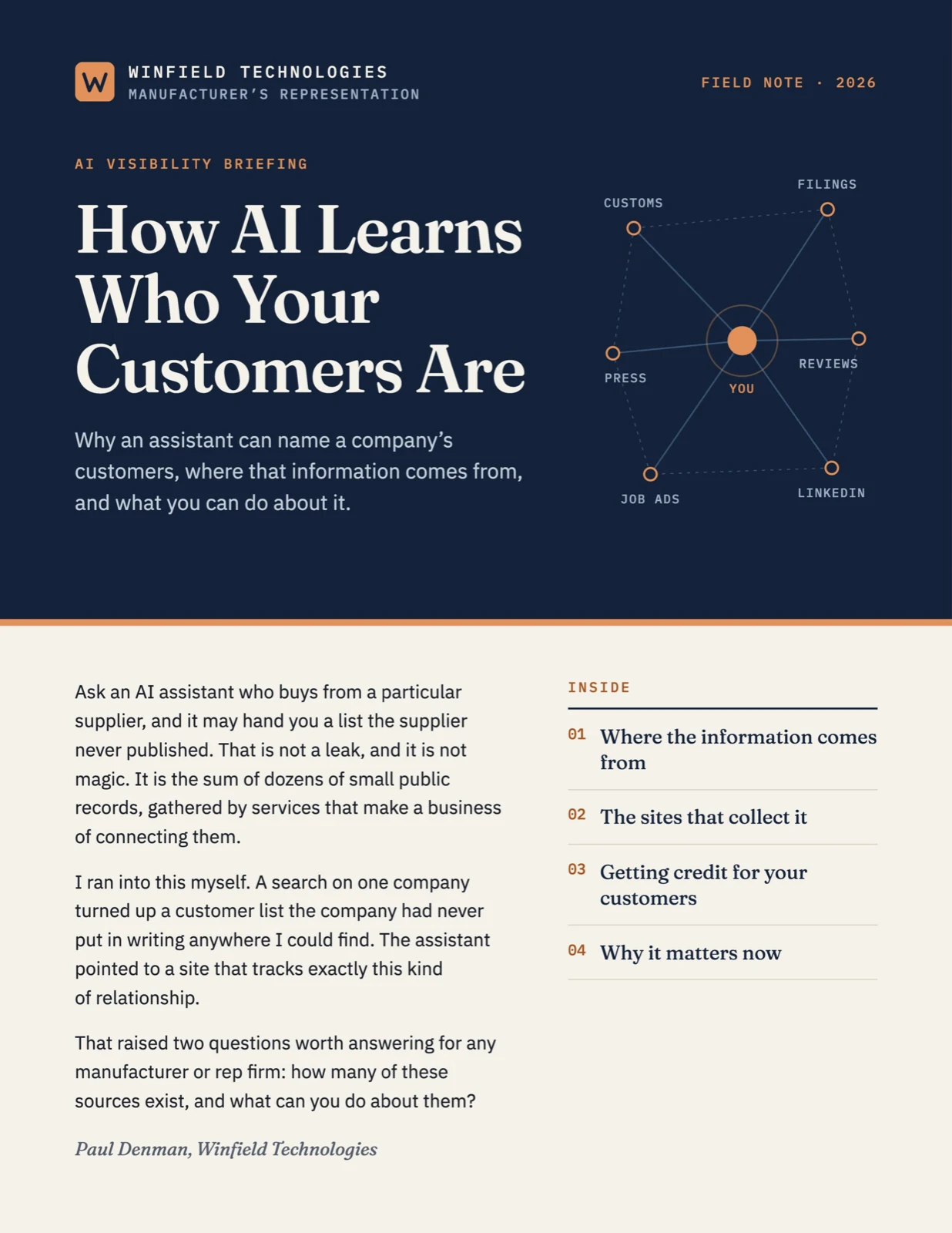
Most business relationships leave a paper trail, even when nobody means to announce one. Put the scattered pieces side by side and the picture fills in quickly.
- Customs records. Every ocean shipment into the U.S. is logged on a public bill of lading naming the shipper and receiver. For hardware companies, this is usually the biggest exposure.
- Job postings. An ad asking for experience with a specific brand of motor or controller tells the world which vendor that employer uses.
- LinkedIn profiles. Engineers and buyers list the products they've designed with and the suppliers they manage.
- Public filings. Public companies must disclose any customer above ten percent of revenue, and many name key suppliers too.
- The customer's own words. Supplier pages, partner logos, spec sheets, press releases, conference slides. All of it names names.
- Reviews. A review left on a business software site usually shows the reviewer's company.
- Government contracts. Federal awards, and many state and local ones, get published in full.
An AI assistant reads all of this at once. What looks like inside knowledge is simply a lot of public detail, assembled faster than a person could manage.
The sites that collect it
There are hundreds of these services, but a few dozen do most of the work. They fall into six broad groups.
- Shipping and customs data. ImportYeti (free), ImportGenius, Panjiva, Descartes Datamyne, Volza, Trademo. Shows who ships to whom, how often, and roughly what. For manufacturers, this is the first place to look. Search your own company name here; it's often an eye-opener.
- Supply chain mapping. Bloomberg SPLC, FactSet Revere, Sayari, Altana, Resilinc, Craft.co. Maps supplier and customer networks, often several tiers deep.
- Technology tracking. BuiltWith, Wappalyzer, HG Insights, Enlyft, 6sense, TheirStack. Tracks which companies use which products, pulled largely from job ads and website code.
- Company and sales databases. ZoomInfo, Apollo, Crunchbase, PitchBook, CB Insights, Owler, Tracxn. Company profiles, contacts, funding, known partners.
- Reviews and customer lists. G2, Capterra, TrustRadius, Gartner Peer Insights, FeaturedCustomers. Named customers, in their own words.
- Government contracts. USAspending.gov, SAM.gov, GovSpend, GovWin. Public agencies and the vendors they buy from, published in full.
Getting credit for your customers without naming names
Many of us can't post a customer list. The good news: AI gives more weight to what others say about you than to what you say about yourself.
- Let the customer tell the story. A case study on their site, in a trade magazine, or on a distributor's page outweighs anything on your own.
- Encourage engineers to post. A customer engineer's LinkedIn post that tags your company gets read and indexed.
- Ask for reviews. A handful of honest reviews on G2, plus a FeaturedCustomers profile, go a long way.
- Write anonymized case studies. "A Tier 1 medical device maker in the Midwest" protects the customer and still shows your industries.
- Share news through partners. A joint release with the manufacturer or distributor announces a design win without your letterhead.
- Speak at trade events. Talks given with a customer leave slides and abstracts that stay indexed for years.
One rule for all of it: get the customer's permission first, in writing if any agreement is involved.
If you'd rather stay private: importers and exporters can ask U.S. Customs and Border Protection to keep their names off public shipping manifests under 19 CFR 103.31. It's free and renews every two years. Few companies bother, which is why shipping data is so revealing. Beyond that: watch job postings for brand names, ask customers not to list you when discretion matters, and search these sites for your own company now and then.
Why it matters now
Your next buyer has likely already asked an AI about you. Recent buyer surveys show how far the shift has gone.
- 94% of B2B buyers use AI tools during the buying process.
- 79% of software buyers say AI search changed how they research.
- 72% saw Google AI Overviews while researching.
- 60% use ChatGPT or Gemini to build vendor lists.
And what happens next:
- 80% of deals go to the vendor the buyer already favored before first contact.
- 90% of buyers click through to verify what an AI told them.
- 20% felt less confident after an AI gave them inaccurate answers.
Buyers once met a company through its catalog, its salespeople, and word of mouth. Today the first stop is often an AI assistant, which forms its opinion from the public record. You can't control all of that record. With a little care, you can decide which parts tell your story best.
Sources: 6sense 2025 Buyer Experience Report (94%, 80%); G2 2025 CMO Buyer Behavior Report (79%); TrustRadius 2025 buyer research (72%, 90%); Google 2025 B2B buyer research (60%); Forrester 2025 buyer research (20%).